

Pakistan’s textile industry runs on tight margins and high energy prices. Mills are chasing every saving they can find — rooftop solar, efficient motors, heat recovery. But one of the biggest energy costs in a textile plant is also the most overlooked: compressed air.
With the 34th Textile Asia 2026 incorporating a Textile Solar Sustainability & Energy Expo (5–7 December, Karachi Expo Centre), there’s no better time to look hard at it.
Why compressed air matters so much in textiles
Compressed air is everywhere on a textile floor — pneumatic controls, cleaning, material handling, and above all air-jet weaving, where looms fire a jet of compressed air to carry the weft across the shed, thousands of times an hour, on every loom.
That adds up fast. In air-jet weaving mills, compressed air can be the single largest electricity consumer on site — in one documented fabric mill, it accounted for roughly 60% of total electricity use. For a spinning, dyeing or finishing operation the share is smaller, but compressed air is still a major, continuous load that runs whenever the plant does.
Where the money leaks away
Most of the cost of compressed air isn’t the air that does useful work — it’s the waste around it:
- Leaks. A typical compressed-air system loses 20–30% of the air it produces to leaks in fittings, hoses, couplings and drains. On a noisy mill floor you simply can’t hear them, so they run around the clock — and you pay for every cubic metre.
- Over-pressure. Running the system higher than the process needs is common “just to be safe.” But every 2 psi of extra pressure adds about 1% to energy consumption, and increases the leak rate too.
- Fixed-speed compressors. A conventional machine runs at full power regardless of demand. In a mill where air demand rises and falls across shifts and processes, that means paying full price for part-load work.
How to cut the compressed-air energy bill
The good news: the fixes are proven and practical.
Variable-speed (VSD) compressors with permanent-magnet (PM) motors. A VSD compressor matches its output to real-time demand instead of running flat-out, and a PM motor stays efficient across the whole speed range. On the variable load profile typical of a textile mill, this can cut compressed-air energy by up to 35% (model- and load-dependent).
Leak and pressure management. Finding and fixing leaks, and setting pressure to what the process genuinely requires, is often the cheapest energy saving available.
Correct air quality. Oil-free compressors protect dyeing and finishing processes from oil carry-over that causes fabric defects; proper dryers and filters remove the moisture and particulate that damage both fabric and pneumatic equipment. Better air quality means fewer rejects and less maintenance downstream.
One figure is worth keeping in mind when comparing machines: over its working life, around 70% of a compressor’s total cost is electricity — not the purchase price. The cheapest machine on day one is usually the most expensive over ten years. Buy on efficiency, not on sticker price.
A free energy check at Textile Asia 2026
SKY Air Compressors supplies German-engineered, energy-efficient compressed-air systems — VSD and PM-motor screw compressors, oil-free systems, refrigerated and desiccant dryers, and precision filters — specified for Pakistani operating conditions (45°C+ heat, coastal humidity) and supported locally through Sakoon Pneumatics.
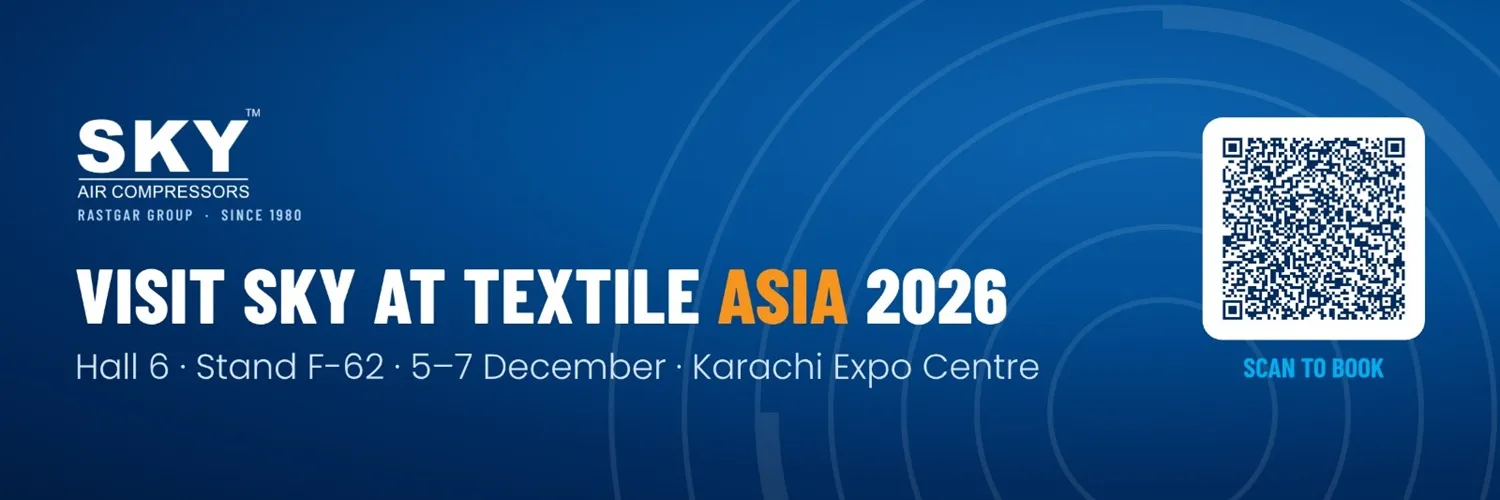
Visit us at Textile Asia 2026 — Hall 6, Stand F62–F63 (Rastgar Group) — and get a free on-site compressed-air energy check. Bring your current compressor’s kW rating and working pressure, and a rough idea of your monthly bill, and we’ll tell you honestly whether there’s a saving worth chasing.
📍 Hall 6, Stand F62–F63 · 🗓 5–7 December 2026 · Karachi Expo Centre
German quality, half the price. Rastgar Group, bringing compressed-air technology to Pakistan since 1980.
📞 +92 334 593 3391 · ✉️ info@skyair-compressors.com

